630-584-4800

-

- Home
- Our Firm
- Divorce
- The Illinois Divorce Process
- Grounds for Divorce
- Alimony / Maintenance
- Child Custody / Parental Responsibilities
- Parenting Time
- Child Support
- The Stay at Home Parent and Divorce
- Property Division
- High Asset Divorce
- Tax Implications of Divorce
- Divorce for Older Couples
- Uncontested Divorce
- High Conflict Divorce
- Change in Venue or Jurisdiction
- Subpoenas
- Annulments
- Post Divorce Modifications
- Post Divorce Enforcement and Contempt of Court
- Workers Compensation Claims and Personal Injury Claims in Divorce Cases
- Family Law
- Criminal Defense
- Blog
- Media
- Contact

Who Pays Credit Card Debt if We Get Divorced?
 As Americans struggle with inflation, supply chain issues, and rising prices, many are turning to credit cards to make ends meet. Credit cards can be a useful financial tool. However, credit card debt can quickly spiral out of control. According to a study by WalletHub, the average U.S. household has around $11,000 in credit card debt. When a household comes apart, that debt will have to be addressed one way or another.
If you are getting divorced, you may have many questions and concerns about credit card debt. How is credit card debt divided between spouses? Do we have to pay off our credit cards before we can divorce? What if a spouse promises to pay credit card debt and fails to do so? At Goostree Law Group, our St. Charles, IL divorce attorneys can help you address these questions and much more. We have garnered over 100 5-star reviews, so you can trust us to provide you with legal advice and guidance unique to your situation.
Am I Responsible for My Spouse’s Credit Card Debt in Illinois?
Illinois courts handle debt similarly to property in a divorce (750 ILCS 5/503). A debt that a spouse acquired before getting married is usually non-marital, while debts acquired during a marriage are marital debt or joint debt. However, many different factors can influence liability for debts in a divorce. Sometimes part of a debt is considered marital and part of it is considered non-marital.
Both spouses are responsible for marital debt, but they may be able to negotiate debt payment terms during property division discussions. For example, the spouse responsible for paying a debt may be given a greater share of the marital assets to account for this.
What Happens If Credit Card Debt Is Not Paid After Divorce?
Divorcing spouses are often encouraged to pay down debt, especially credit card debt, as much as possible in a divorce. Some financial professionals will advise spouses to sell assets to pay off debt, so they do not have to worry about it after the divorce. This gives the spouses an opportunity for a fresh start. Of course, not everyone is in a position to completely eliminate debt in anticipation of a divorce.
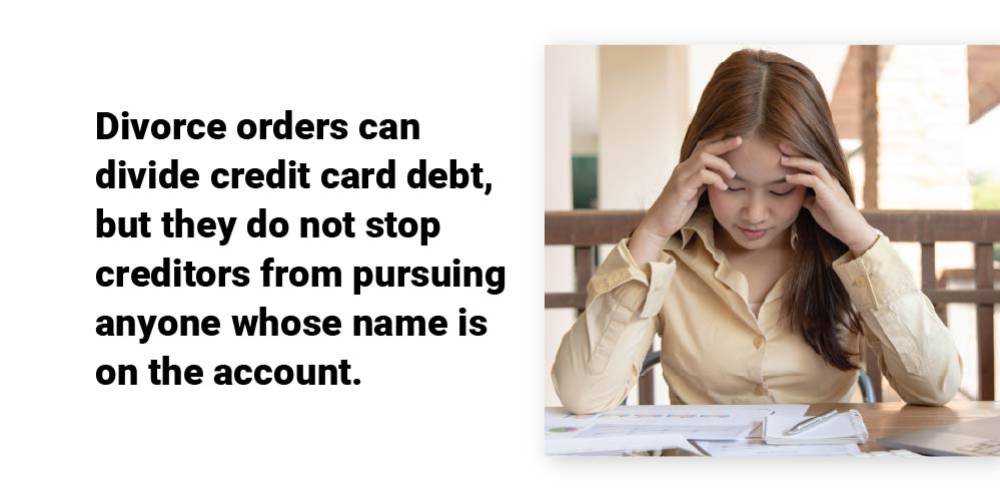
If you decide to divide joint credit card debt between you and your spouse during your divorce, you should know that credit card companies are not bound by the terms of a divorce. If a debt is in both spouses’ names, the creditor has the right to pursue both people for repayment even after they divorce. It does not matter if your spouse pledged to pay off the debt during divorce negotiations.
If your name is attached to the debt, you could be on the hook for the debt if your spouse fails to fulfill his or her obligations. This is one of the reasons why it is so important to work with an experienced divorce attorney who can ensure you are taking the steps needed to protect yourself and your credit score during divorce.
How Does Equitable Distribution Affect Credit Card Debt in 2026?
If you and your spouse can’t agree on how to divide your credit card debt, the court will use the principle of equitable distribution to resolve the issue. This means the court aims for a fair division of property and debts. However, "fair" does not always mean a 50/50 split. The judge looks at many parts of your situation before deciding who pays which credit card bills.
The reason behind the debt may be a major factor in how it is divided. If one spouse used cards to pay for family needs, like groceries, medical care, or kids’ clothes, the court may treat it as a shared burden. If one spouse secretly used cards for gambling, an affair, or luxury items only for that person, the court may assign more of that debt to that spouse.
Income and earning ability matter as well. A spouse who earns much more may be ordered to cover a larger share of the total debt. The court can also consider any waste of marital assets, and how property is being divided. All of these details come together in the final order about who pays which credit card accounts.
Can You Avoid Credit Card Debt With a Prenup?
A prenuptial agreement can help protect you from some credit card debt in a future divorce. In a prenup, you and your future spouse can decide in advance how to handle certain debts. You might agree that each person will be responsible for cards in their own name, or that certain types of charges will stay separate.
However, a prenup must follow certain rules. Both parties must give full and honest information about their income, property, and debts before signing. If one person hides major credit card debt, the agreement may be challenged later. Each person should also have time to read the agreement, ask questions, and talk to a lawyer if possible.
The terms of the prenup must also be reasonable. A judge can choose not to enforce a prenup that is "unconscionable," or grossly unfair to one side. For instance, if one spouse is made to pay for a vast majority of debts without good reason, it could be considered unconscionable. When a prenup is properly drafted and both sides understand the terms, it can give more control over how credit card debt is handled if the marriage ends.
Contact a Kane County, IL Divorce Lawyer
If you are getting divorced and you have credit card debt, work with our accomplished St. Charles, IL divorce attorneys for help. Call Goostree Law Group at 630-584-4800 to schedule a free consultation.

Schedule a Consultation Today
Complete the contact form below or call us at 630-584-4800 today.
Free Consultations
630-584-4800
555 S. Randall Road, Suite 200
St. Charles, IL 60174
Follow Us